What are the subtle signs of anxiety in dogs?
The dramatic signs — shaking, hiding, howling, destruction — are the top of the ladder. The bottom rungs look like this:
| Sign | What it looks like | Easily mistaken for |
|---|---|---|
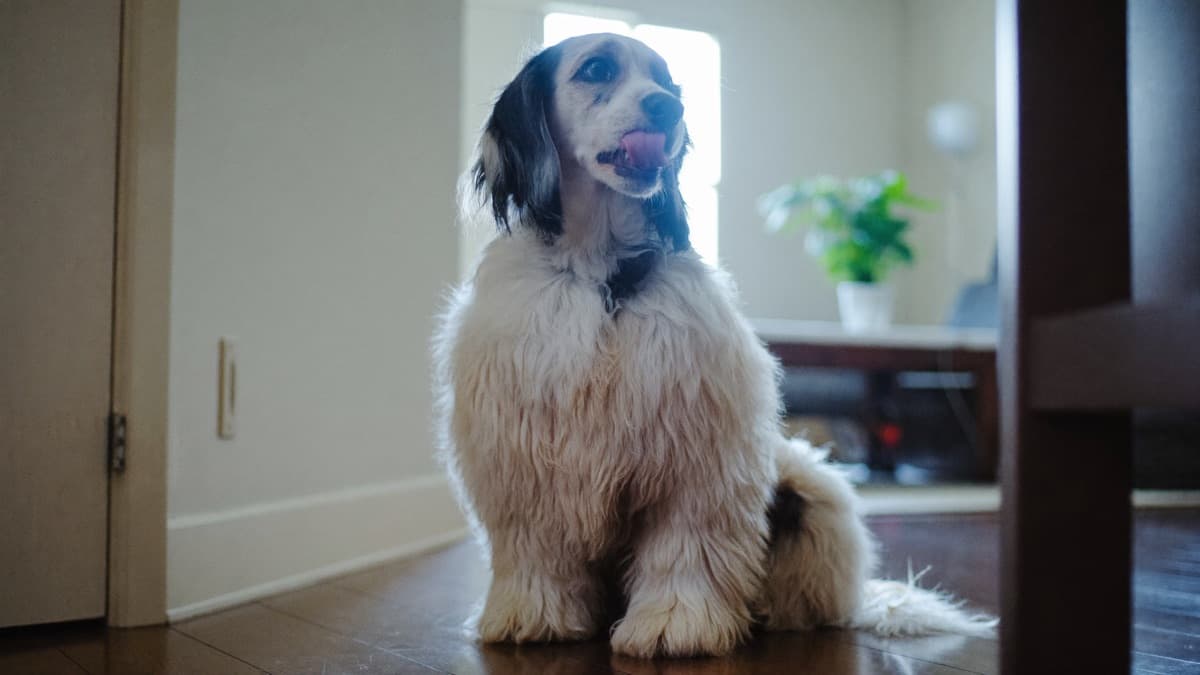
| Lip licking | Quick tongue flicks with no food around | Hunger, "kisses" |
| Yawning | Repeated yawns when not sleepy, often exaggerated | Tiredness |
| Pacing | Circuits of the flat, can't settle in any spot | Restless energy |
| Sweaty paws | Damp paw prints on tiles or the vet's steel table | Wet floor, spilled water |
| Shedding spike | Sudden handfuls of loose coat during stress (vet visits, guests) | Seasonal coat blow |
| Whale eye | Head turned away but eyes fixed on the worry, whites showing | "Guilty look" |
| Shake-off | Full-body shake with a dry coat, after a tense moment | Wet-dog shake |
| Displacement behaviours | Sudden scratching, sniffing the ground, licking a paw mid-interaction | Itchiness, distraction |
| Appetite loss | Refusing treats they'd normally inhale | Fussiness |
| Panting | Open-mouth panting in air-con, no heat or exercise | Being warm |
One sign in isolation means little — dogs yawn because they're sleepy, too. Read clusters and context: three signals appearing together when the trigger walks in is a sentence, not a coincidence. Our dog body language guide covers the full vocabulary, and why is my dog shaking sorts fear-trembling from the medical causes.
Is it situational anxiety or generalised anxiety?
Situational anxiety has an on-switch and an off-switch: a specific trigger (thunder, fireworks, being left alone, the lift, the groomer) turns the signs on, and its departure turns them off. The big three in Singapore and Malaysia are noise fears — see the thunder and fireworks guides — and separation anxiety, which is panic specifically about being alone.
Generalised anxiety has no clean trigger: the dog scans, startles, paces and shows the table's signals through ordinary days — hypervigilant on calm walks, unable to nap deeply, worried by nothing in particular and everything slightly. It often grows from unaddressed situational fears that spread, from under-socialisation, or simply from genetics; anxious parents produce anxious puppies at meaningful rates.
The distinction drives the plan: situational anxiety responds to trigger-specific training, while generalised anxiety usually needs whole-life management and, often, medication.
What helps at each level?
Mild, occasional worry — a few table signals around specific events, quick recovery: your job is prevention. Give the dog control and escape routes (a bed nobody bothers, the option to leave greetings), pair mildly worrying things with food, and protect sleep — adult dogs need 12+ hours daily and chronic under-sleeping feeds anxiety. Predictable routines and sniff-heavy walks are quietly powerful.
Moderate, repeating anxiety — signals appear daily or a trigger reliably causes distress: add structured work. Desensitisation and counterconditioning for the trigger, management so the dog stops rehearsing the fear, and enrichment that pays out calm (lick mats, food puzzles, chew sessions). What has no place at any level is punishment: correcting an anxious dog's growl, bark or pacing suppresses the signal while deepening the emotion — AVSAB's guidance is unambiguous that aversives increase fear and aggression risk.
Severe or generalised anxiety — panic states, self-injury, escape attempts, a dog that can't switch off: this is professional territory, without delay.
When does anxiety need a professional — and medication?
See help when anxiety damages quality of life: the dog can't be left alone, can't walk the estate, injures itself, stops eating, or you're organising your household around avoiding its triggers. Start with a vet visit to rule out medical drivers (pain, thyroid disease and cognitive decline all masquerade as anxiety), then a force-free trainer or veterinary behaviourist — in Singapore, the AVS-Accredited Certified Dog Trainer list is the vetted starting point.
And say the quiet part clearly: medication is not failure. Chronic anxiety is a medical state — a brain marinating in stress hormones — and modern behaviour medications lower that baseline so training can finally land. They are not sedation, they don't blunt personality, and refusing them for a genuinely suffering dog helps no one. Plenty of dogs use medication for a season of intensive behaviour work and taper off; some need it long-term, exactly like any other chronic condition. The dogs that do worst are the ones whose whispers were ignored until they became shouts — start at the table above, and start early.