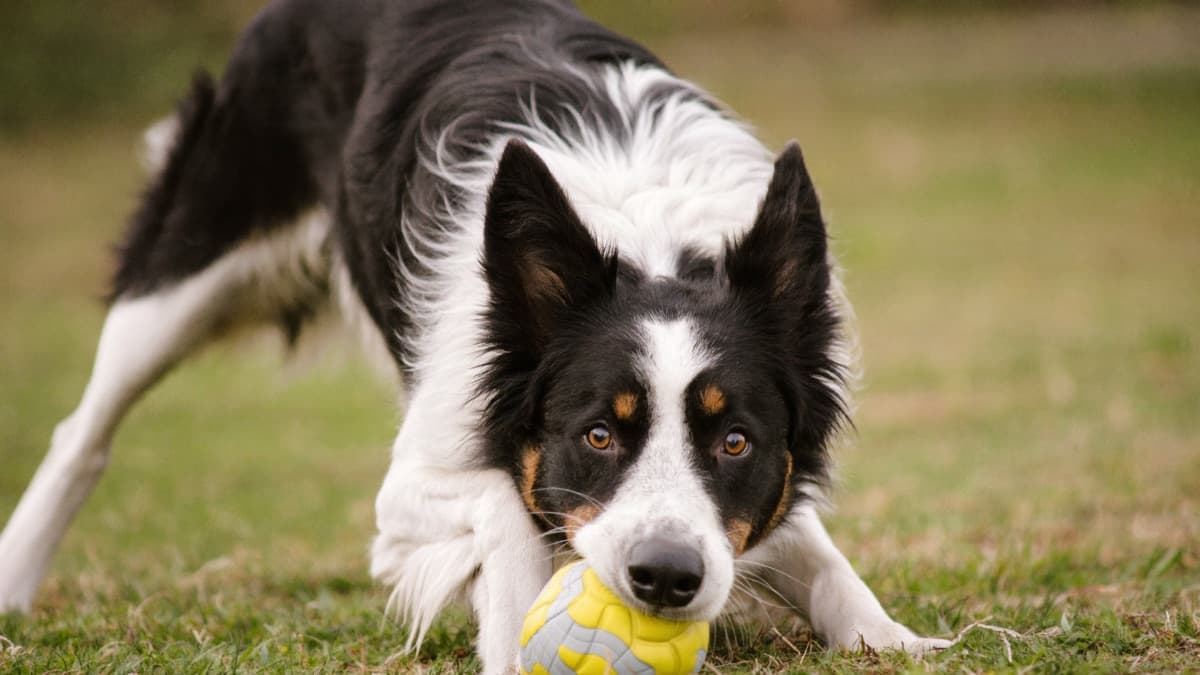
| Quick facts | |
|---|---|
| Size | Medium (46–56 cm at the shoulder) |
| Weight | 14–20 kg |
| Lifespan | 12–15 years |
| Coat | Double coat, smooth or moderately long; regular shedding |
| Exercise | Very high — 90+ minutes daily plus serious mental work |
| HDB-approved | No — private housing only |
What is a Border Collie's temperament really like?
Intense. That is the word that matters more than "smart." A Border Collie watches everything, learns in two repetitions (bad habits included), and brings workaholic focus to whatever job it has — and if you do not give it a job, it appoints itself one. Common self-appointed jobs include herding your children, stalking the cat, spinning at shadows, barking at every corridor sound, and dismantling the sofa to see what is inside.
The herding instinct is not a party trick; it is the operating system. Eye, stalk, chase, nip — these sequences fire at joggers, bicycles, motorbikes, and running kids. Managed and channelled, they make the greatest sports dog alive. Unmanaged in a small home, they make a neurotic, reactive dog, and under-stimulated Border Collies are disproportionately represented in behaviour consultations for obsessive-compulsive spinning, light-and-shadow chasing, and noise reactivity. Many are also sound-sensitive by nature — thunderstorm season here is a real consideration.
None of this is the dog failing. It is the owner buying a Formula 1 car for school runs.
The under-stimulation equation in a flat
Here is the honest arithmetic for this region. The safe outdoor exercise window in Singapore or Malaysia is roughly before 9 am and after 6 pm. A Border Collie needs 90-plus minutes of physical outlet daily, plus 30–60 minutes of genuine mental work — training, scent games, puzzle feeding, trick chains — every day, for 14 years, including the weeks when work is heavy and it rains at dawn.
Miss that quota for a fortnight and you will meet the consequences: barking that gets you complaint letters, chewed furniture, herding nips at visitors, and stereotypic behaviours that are much easier to prevent than to reverse. Mental work is not optional garnish; a tired body with a bored brain is still a problem dog. This is why the breed fails in flats — not because it cannot physically fit in 90 square metres, but because almost no household can sustain the schedule.
If you are the exception — and some households genuinely are — the outlets exist locally: obedience and trick training, canine agility and flyball classes run by dog-sport groups in both Singapore and Malaysia, scent-work courses, treibball, and swimming at dog pools. Verify current class availability with trainers near you before you buy, not after; the sport scene is real but small, and waiting lists are common.

What health problems do Border Collies have?
A structurally sound, long-lived breed by pedigree standards, with a short but important screening list. Collie eye anomaly (CEA) is a DNA-testable inherited eye condition; both parents should be tested. Hip dysplasia occurs, so buy from hip-scored parents. Trapped neutrophil syndrome (TNS) and neuronal ceroid lipofuscinosis (CL) are fatal recessive diseases with cheap DNA tests — no responsible breeder skips them. Some lines carry the MDR1 mutation affecting drug sensitivity; testing is inexpensive and worth knowing before your vet ever prescribes. Epilepsy and deafness appear in some lines, and sound sensitivity, while behavioural, has a heritable component worth asking breeders about.
In the tropics, add the double-coat routine: never shave, rake the undercoat weekly, dry thoroughly after rain, and check for hot spots. The coat is less extreme than a Husky's but the humidity rules are the same.

Can a Border Collie live happily in Singapore or Malaysia?
A minority of homes can do this well; most cannot, and it is kinder to say so.
Housing. Not HDB-approved — private housing only in Singapore, and realistically a home near large parks or with garden space. Verify the current list yourself.
Climate. The workload has to fit into cool hours, which compresses an already demanding schedule. Swimming and indoor mental work carry the midday load. A fit, lean, well-raked Border Collie copes with the heat; an overweight, overcoated one does not.
The right home looks like this: someone home much of the day or a genuine dog-sport hobbyist, private housing, an appetite for daily training as recreation rather than chore, and a plan for thunderstorms and travel. If that is you, there is no more rewarding teammate in dogdom.
Who should not get a Border Collie?
Most flat-dwelling households, full-time-out families, first-time owners, and anyone buying on intelligence as a selling point — a brilliant dog is harder to live with, not easier. If you want a clever, trainable companion at sustainable intensity, meet a Poodle or a Sheltie first. If you want a working partner and can pay the daily tax in time and training for 14 years, the Border Collie has no equal.