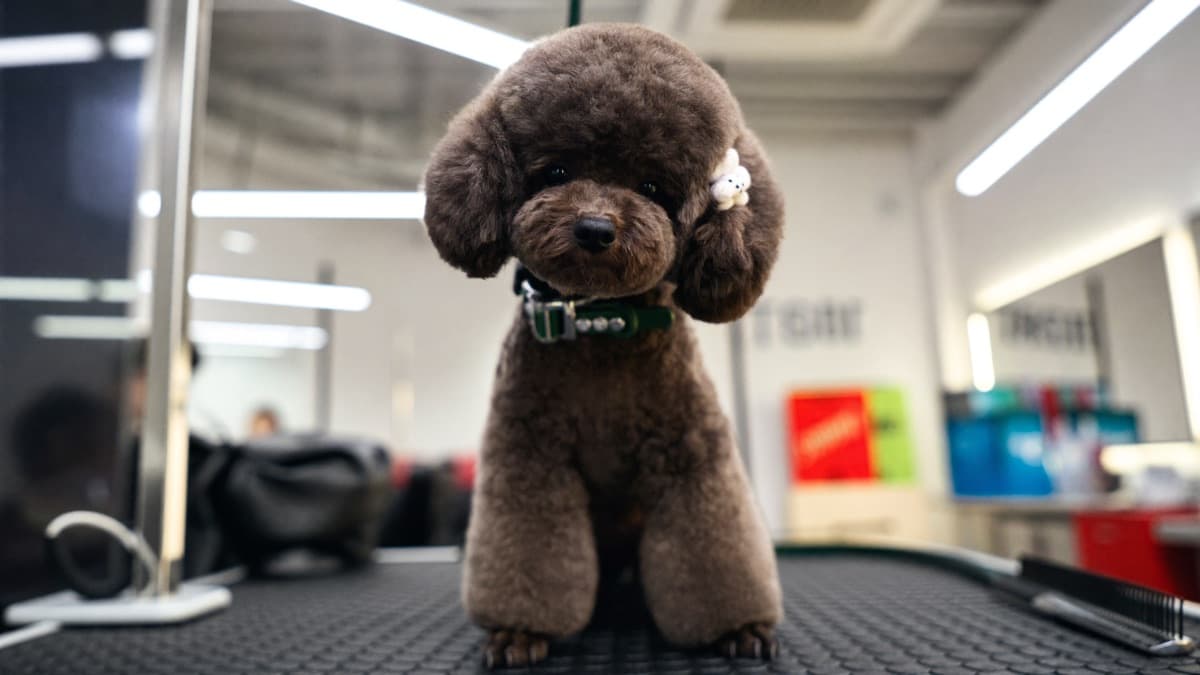
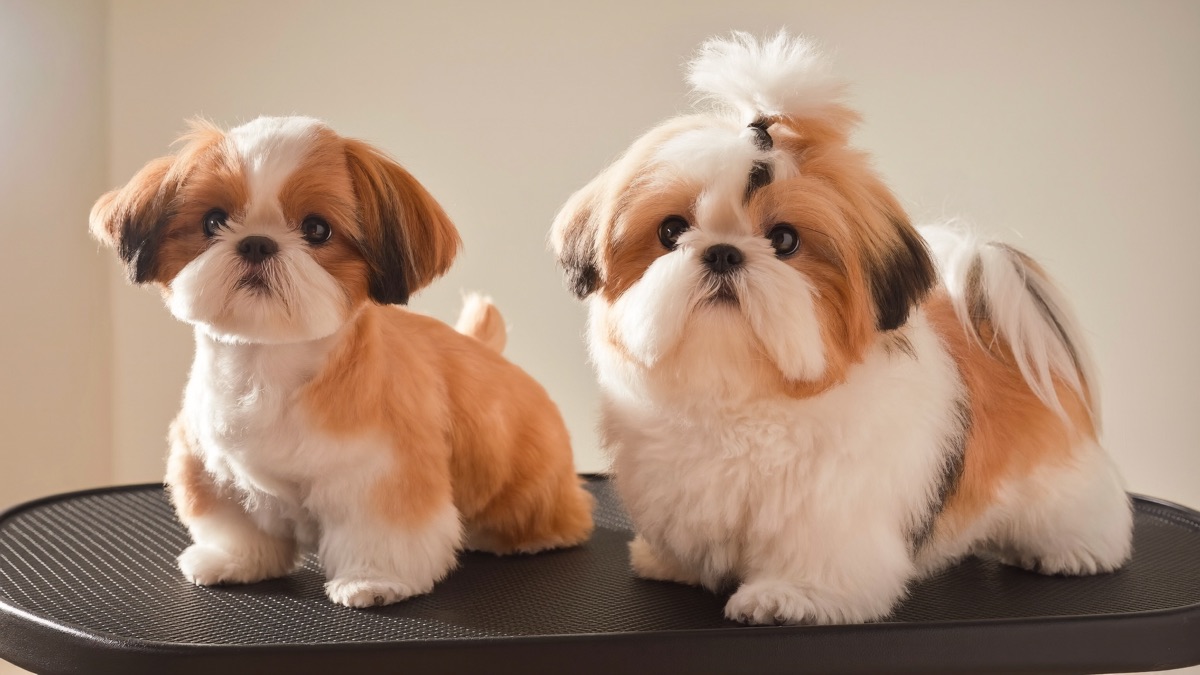
| Puppy cut | Teddy bear cut | |
|---|---|---|
| Body | Even short length, ~1–3 cm | Short, like a puppy cut |
| Face & head | Same short length as body | Left fuller, scissored round |
| Best for | Low-maintenance tropical clip | A plush, "soft toy" look |
| Upkeep | Lowest | Face needs combing or it mats |
The rest of this guide covers every common style, which suits each coat, and why a shaved double coat is a mistake.
What are the common grooming styles?
- Puppy cut — one even, short length over the whole body, face, and legs, typically 1–3 cm. The default low-maintenance tropical clip for Poodles, Shih Tzus, Malteses, and mixes. Despite the name it has nothing to do with puppies.
- Teddy bear cut — body clipped short like a puppy cut, but the face and head left fuller and scissored into a rounded, plush shape. The Instagram favourite for Toy Poodles and Bichons. The round face needs combing between grooms or it mats.
- Lion cut — body clipped very short with a full mane over the chest and head, plus a tail plume. Traditional on Pomeranians and popular for novelty — but on a Pomeranian this means clipping a double coat, with real risk the coat never regrows properly. Most experienced groomers will try to talk you out of it; let them.
- Breed-standard trims — the show looks: the Poodle's sculpted trims, the Shih Tzu's floor-length coat, the Schnauzer's skirt and eyebrows. Beautiful, but they assume daily brushing and, in long coats, serious commitment in this humidity. Most owners here run a puppy cut and keep the standard look for photos.
- De-shedding groom / breed tidy — not a haircut: a bath, conditioner, forced-air blow-out, and raking that strips loose undercoat while leaving the coat's length intact. This is the correct "summer cut" for double-coated breeds, all year round here.
Which style suits which coat?
| Coat type | Examples | Styles that work | Avoid |
|---|---|---|---|
| Curly / wool | Poodle, Bichon, "-doodle" mixes | Puppy cut, teddy bear, breed trims | Letting mats force a skin-close shave |
| Long, silky | Shih Tzu, Maltese, Yorkie | Puppy cut, teddy bear, full coat if you'll brush daily | Full coat with no brushing routine |
| Double coat | Corgi, Golden, Shiba, Pomeranian, Husky | De-shedding groom, light tidy of paws/sanitary areas | Any clip-down or shave |
| Short, smooth | Frenchie, Beagle, Singapore Special | Bath-and-tidy only — nothing to style | Clipping (nothing to clip) |
| Wiry | Schnauzer, terriers | Breed trim (clipped or hand-stripped), puppy cut | — |
Why must double coats never be shaved?
A double coat insulates in both directions: the undercoat traps an air layer that buffers heat, and the guard hairs block UV. Shave it and you get direct sun on pink skin, worse heat regulation, and regrowth that's frequently ruined — the undercoat returns before the guard hairs, leaving a patchy, felty texture (clipper alopecia) that can be permanent, especially in older dogs. The tropical answer for a hot Corgi or Golden is the de-shedding groom above, plus shade, water, and aircon on the worst afternoons. A salon that pushes back when you ask to shave one is showing you good judgement, not inflexibility.
What should I actually tell the groomer?
- Photos, front and side — of another dog or of your own dog after a groom you loved. Salons here will happily keep them on file.
- A number, not an adjective: "1 cm on the body" survives translation; "short-ish but fluffy" doesn't.
- Call out the details: face round or tidy? Ears long or trimmed level with the jaw? Tail plume kept? Feet rounded or tight?
- State your hard limits: "Don't shave the body", "keep the tail", "if she's matted, call me before clipping short."
- Say what daily life looks like — a dog that swims weekly or hates brushing needs a shorter, simpler style than the photo you saved.
How long does growing out take?
Clipped hair on curly and silky breeds regrows at roughly 1–1.5 cm a month, so a 1 cm puppy cut takes about three to four months to reach a fluffy 5 cm, and a botched groom is fully erased in a couple of cycles. Growing a Shih Tzu or Maltese from puppy cut to floor-length is a one-to-two-year project of daily combing — in this humidity, mats form fast in transitional-length coat, so most owners book more frequent tidy-ups during a grow-out, not fewer. A shaved double coat is the outlier: a year or more, if it recovers at all.
In Singapore and Malaysia most salons book grooms every four to eight weeks; as of 2026 a small dog's full groom runs about S$70–S$120 or RM60–RM100. For package details, pricing by size, and the red flags that should send you elsewhere, see our full grooming guide for Singapore and Malaysia.