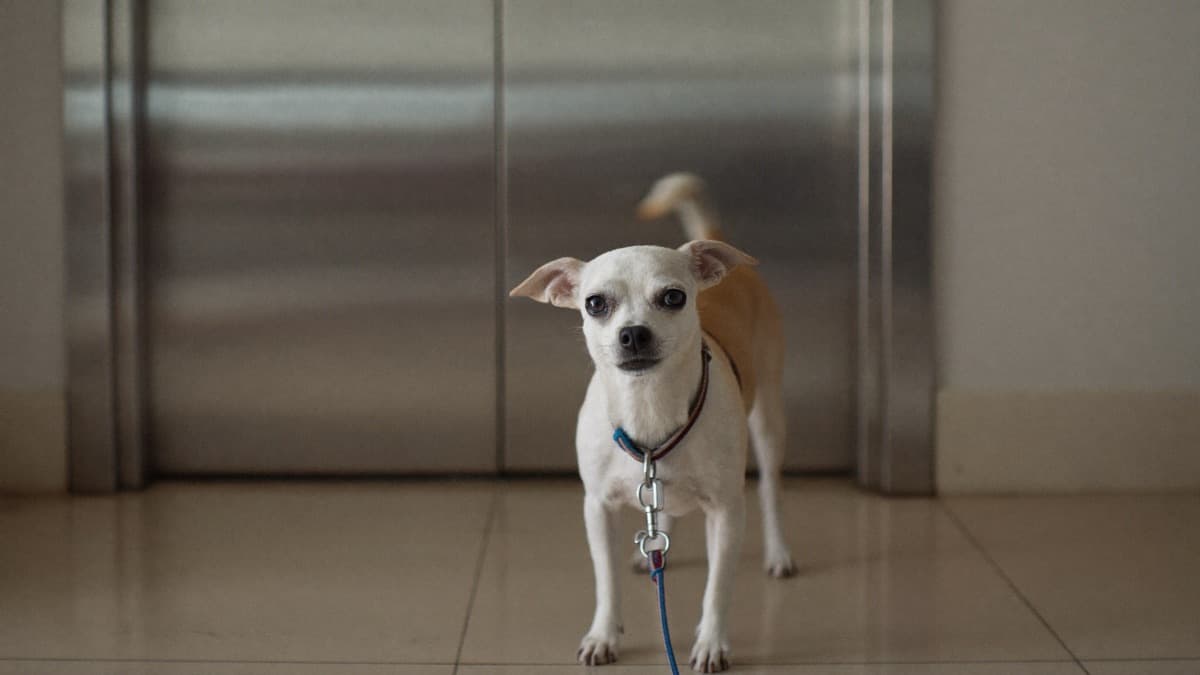
Why are lifts so frightening for dogs?
Each element alone is manageable; stacked together they overwhelm:
| Trigger | What the dog experiences |
|---|---|
| Motion | The floor drops or rises with no visual cue — inner-ear confusion similar to car sickness |
| Confinement | A small box, doors sealed, no escape route — the option to retreat is gone |
| Strangers | Doors open and unfamiliar people step in at nose height, sometimes reaching to pat |
| Sound and vibration | Whirring cables, chimes, juddering stops — all amplified in a steel shell |
Dogs communicate discomfort before they refuse outright: lip licks, yawning, a tucked tail, planting at the lift lobby. Learn these early signals in our dog body language guide — catching them means you can make the next ride easier instead of forcing a worse one.
What is the empty-lift practice ladder?
Desensitisation and counterconditioning (DSCC): break the lift into tiny steps and pair each one with food, only climbing to the next step when the current one is boring. Practise at off-peak hours — mid-morning or early afternoon on weekdays — when you can realistically get an empty lift.
- Lobby only. Sit near the lift doors, scatter a few treats, leave. Repeat until the lobby predicts snacks, not rides.
- Doors open, no entry. Call the lift, let the doors open, treat outside, let it leave without you.
- Step in, step out. Walk in, scatter treats on the floor, walk straight back out before the doors close. This treat-scatter on entry becomes your permanent ritual — head down eating is incompatible with panicking.
- Doors close, no travel. Ride nowhere: doors shut, treats, doors open, exit calmly.
- One floor. A single-floor hop, treats throughout, out and a sniffy break.
- Full rides. Build to your actual floor, then to rides with one calm stranger, then normal traffic.
Each step should take a session or three; if your dog stops eating or tries to leave, drop back a step. Slower is faster.
Where should my dog stand in the lift?
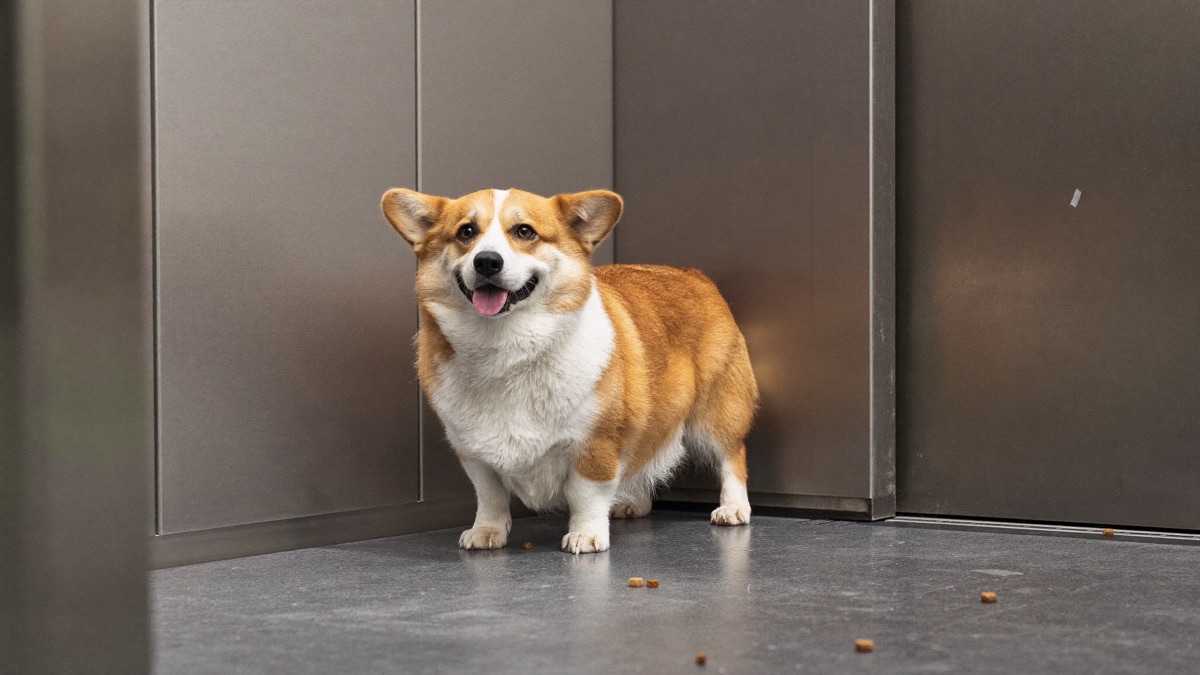
The back corner, beside you. A corner gives two solid walls, keeps paws and tail clear of the door track, and puts your legs between the dog and anyone who enters. Teach it deliberately: scatter the entry treats in the corner so the dog drives itself there, then reward calm standing or a sit facing the doors. Never let the dog ride nose-to-the-gap at the doors — that's where startles, pinches and lunges happen.
What do I do about strangers in the lift lobby?
Lift lobbies funnel neighbours, delivery riders and curious children into close range with no room to give distance. Be your dog's advocate: a cheerful "he's in training, please don't pat" solves most encounters, and letting one lift go by rather than squeezing into a crowded car is always the right call. If strangers themselves are the bigger issue — barking, hiding, growling at people beyond the lift — work through our dog scared of strangers guide alongside this one, because a dog that fears people will never relax in a box full of them.
What are the alternatives while we train?
Management stops the fear rehearsing while the ladder does its work:
- Stairs for small and medium dogs on low floors — a few flights of stairs is decent enrichment, though skip this for puppies under about five months, giant breeds, and any dog with joint trouble. If stairs are their own battle, see our stairs and escalators guide.
- Carry small dogs for necessary rides; a sling or carrier (S$30-80 / RM90-250 as of 2026) turns the lift into a non-event and prevents door-track paw injuries.
- Off-peak toilet runs so unavoidable rides at least happen in empty lifts.
When is it more than ordinary fear?
If your dog trembles, drools, empties its bladder, or fights the lead at the mere sight of the lift lobby — or if weeks of patient work produce nothing — that's a phobia rather than wariness, and it often travels with other anxieties. Check the wider picture in our dog anxiety signs guide and talk to your vet: short-term anti-anxiety medication can lower the fear enough for training to finally land, and there's no prize for doing it the hard way.