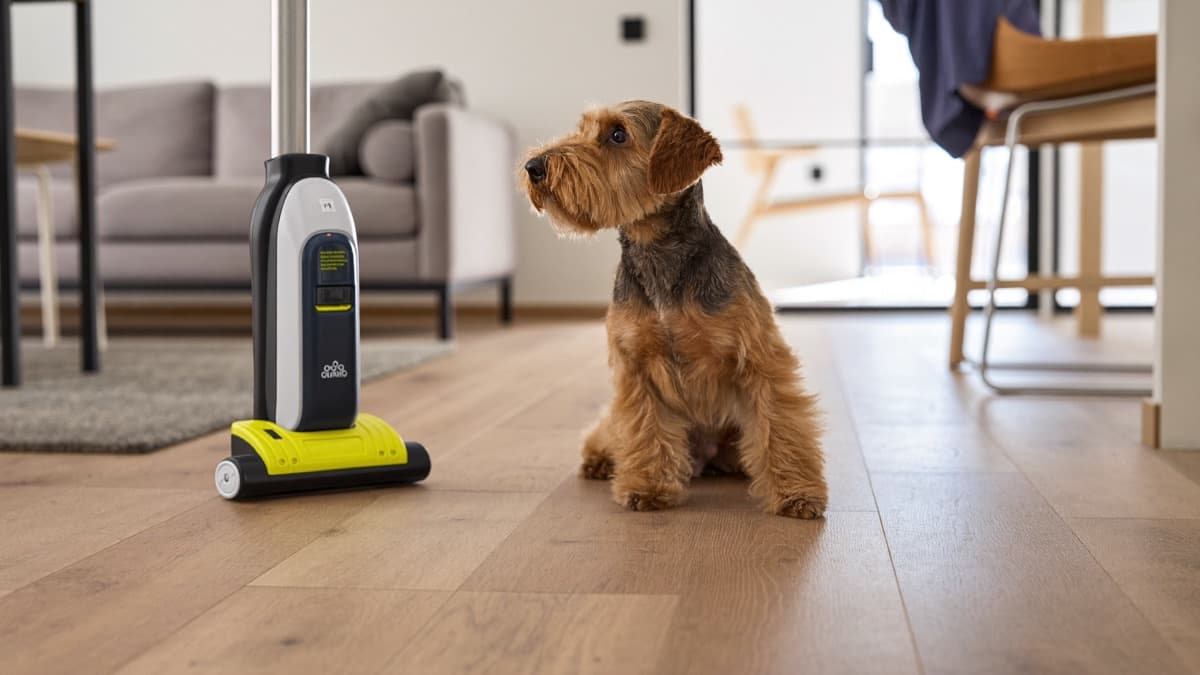
Why do dogs hate vacuums so much?
It's a two-part trigger, and each part alone would be manageable:
- The noise. Vacuums produce loud broadband sound with a strong high-frequency whine — and dogs hear far higher frequencies than we do, so the motor's shriek lands harder on them. The sound also starts abruptly at close range, indoors, with nowhere to go.
- The movement. The head darts forward and drags back, charges at walls, reverses without warning — an erratic, ground-level movement pattern that reads as either predator or prey. Fearful dogs flee it; herding types and terriers often attack it instead.
Add the small-flat factor — in an HDB or condo unit the vacuum passes within a metre of every hiding spot — and weekly cleaning becomes weekly fear rehearsal. A dog that trembles, hides or drools at the vacuum, and startles at other appliances too, may have a broader sound sensitivity worth reading about in our dog noise phobia guide.
What is the vacuum-is-furniture week?
Before any training with the vacuum running, spend a week teaching your dog that a silent vacuum is boring décor:
- Park the vacuum, switched off and unplugged, in the corner of the living room and leave it there all week.
- A few times a day, scatter treats a comfortable distance from it — never lure the dog to touch it; let curiosity set the pace.
- Move it to a new spot every day or two (while the dog is out of the room) so "vacuum exists in this room" becomes normal, not an event.
- Feed a meal or two a few metres from it once the dog is fully relaxed.
Most dogs are ignoring the stationary machine within a week. You've now separated the object from the noise-and-motion show, which makes the next stage far easier.
How do I desensitise my dog to the vacuum running?
Classic desensitisation and counterconditioning (DSCC): add one scary element at a time, paired with excellent food, below the dog's panic threshold throughout.
| Step | What happens | Move on when |
|---|---|---|
| 1 | Vacuum off, you move it slowly, no noise | Dog watches with loose body, eats treats |
| 2 | Vacuum on in the furthest room, door closed, treats where the dog is | Dog eats calmly at first sound |
| 3 | Vacuum on, same room, stationary, short bursts (5-10 seconds) | Dog stays relaxed through a burst |
| 4 | Vacuum on and moving, far side of the room, brief passes | Dog can eat while it moves |
| 5 | Normal cleaning with dog free to leave | Dog chooses to stay or drifts off calmly |
Two rules: sessions stay short (a few minutes), and if the dog stops eating, stiffens or leaves, you've jumped a step — go back down. If you spot subtle stress early — lip licks, whale eye, weight shifted back — our dog body language guide covers what to look for.
Robot vacuums need their own ladder. Don't assume a quieter robot is an upgrade for a fearful dog: it roams unpredictably, pivots without warning and operates when you're not there to manage the encounter, and for some dogs that unpredictability is worse than a loud upright with a visible human attached. Run the same steps — docked and off for a week, then on but stationary, then short supervised runs — and never let a robot free-roam on schedule around a dog that still fears it, because unsupervised scary encounters undo your work. Some dogs also stalk or pounce on robots; a robot that's treated as prey should simply not run while the dog is home.
How do I manage cleaning day while we train?
Training takes weeks; the floor needs cleaning now. Until the ladder is finished:
- Other room, door closed, lick mat. Put the dog in the bedroom furthest from the cleaning with a frozen lick mat or long-lasting chew (S$8-25 / RM25-80 as of 2026) before the vacuum comes out. Licking and chewing self-soothe, and distance plus a closed door drops the volume dramatically.
- Pair with an outing. Even better: one person vacuums while another walks the dog.
- Predict, don't ambush. Keep a consistent pre-vacuum routine so the dog is settled elsewhere before the noise starts, never caught mid-nap beside the machine.
What should I never do?
Never chase your dog with the vacuum "as a joke", push it towards the dog to film a reaction, or laugh off the kids doing it. One deliberate chase can build a fear that takes months to unwind, and it teaches the dog that the scariest thing about the vacuum is you holding it. Equally, don't drag a hiding dog out to "face" the running machine — flooding deepens fear — and don't punish barking at it, which adds pain to panic. If months of patient work still leave your dog panicking at the first click of the power switch, ask your vet whether situational anti-anxiety medication can lower the fear enough for the training to finally stick.