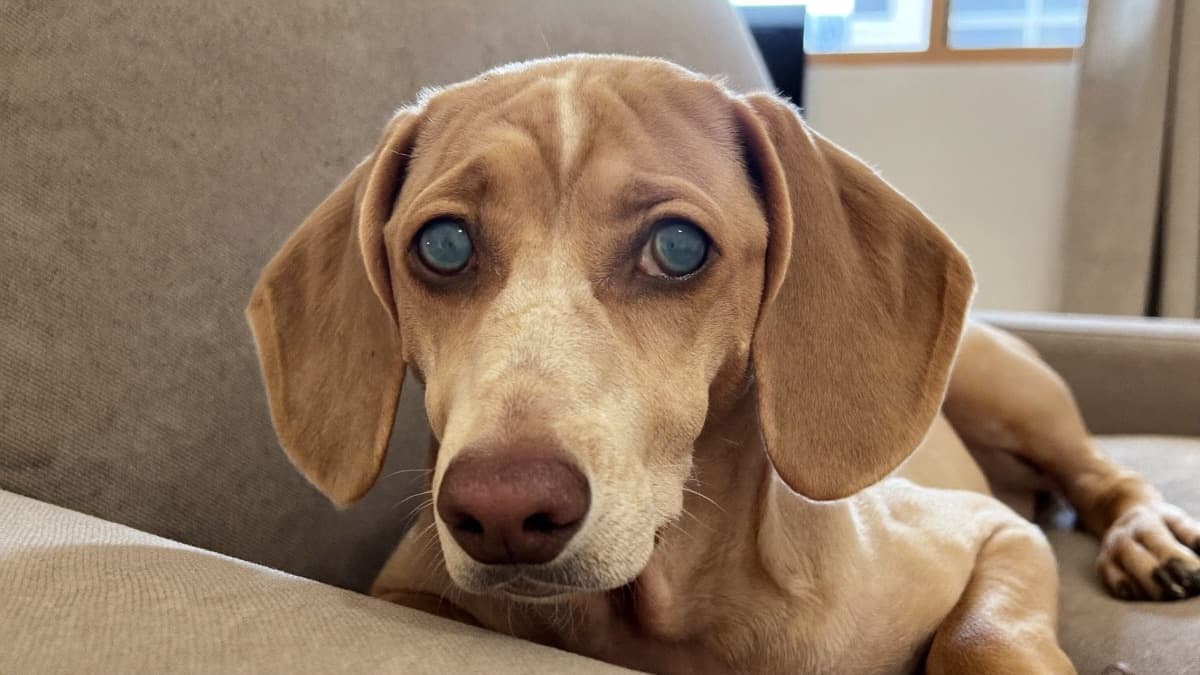
Getting the two straight matters, because one is "monitor at the next check-up" and the other is a treatable, sometimes urgent, condition.
Cataract or normal ageing haze — how do you tell?
| Nuclear sclerosis (usually fine) | Cataract | |
|---|---|---|
| Colour | Even blue-grey haze, like smoke | Whiter, chalky, sometimes crystalline patches |
| Which eye | Both, symmetrically | One or both, often uneven |
| Onset | Gradual from ~6–8 years | Gradual — or fast, especially with diabetes |
| Vision | Largely preserved; maybe worse in dim light | Progressively lost as the lens opacifies |
| Behaviour | Essentially unchanged | Bumping furniture, hesitating on stairs, startling |
The honest limit: owners can't reliably distinguish them by eyeballing the eyeball. A vet shines a light through the pupil — sclerosis lets the view through to the retina, a cataract blocks it. That check takes minutes in a routine consult, so ask at your senior's next visit. Red, painful, or suddenly cloudy eyes are a different, same-week matter — see our guide to red eyes in dogs.
Worth knowing: diabetes is the great accelerator. Most diabetic dogs develop cataracts within a year of diagnosis, occasionally almost overnight. If your senior is also drinking a lot of water, the eyes and the thirst may be the same disease talking.
Can dog cataracts be fixed — and what does surgery cost?
Yes — cataract surgery in dogs is the same operation humans get: phacoemulsification, where the clouded lens is broken up by ultrasound, removed, and usually replaced with an artificial lens. In good candidates, success rates are high and vision returns quickly.
The realistic picture, though:
- It's specialist territory. This is referral-level ophthalmology, and Singapore does have veterinary eye specialists who perform it; in Malaysia, referral ophthalmology services are concentrated around the Klang Valley. Your regular vet refers you — you don't book this directly.
- It costs real money. Expect a bill in the thousands per eye once the pre-surgical workup (including a retinal function test), the surgery, and weeks of follow-up drops and rechecks are included — as of 2026, overseas benchmarks run around US$3,000–6,800 per eye, and local specialist quotes are in the same order of magnitude. Get a written estimate; if you hold pet insurance, check the policy before you need it.
- Not every dog is a candidate. The retina must still work, the diabetes (if present) must be controlled, and the dog must tolerate weeks of eye drops. A good specialist screens honestly for all three.
- Skipping surgery still means monitoring. A mature cataract left alone can leak lens protein, causing painful inflammation and glaucoma. "We're not operating" should come with a follow-up schedule, not a shrug.
Can a blind or low-vision dog still live well?
Genuinely well — dogs run on nose and ears first, and a blind dog in a familiar flat navigates by a mental map you can help maintain:
- Don't move the furniture. The map is the superpower. Keep bowls, beds, and walkways where they've always been, and pad sharp corner edges at head height.
- Lay scent trails. A dab of a distinct safe scent at key waypoints — doorframes, the top of a step — gives the nose landmarks. Textured mats work the same way underfoot: a rug that means "water bowl ahead", a different mat at the balcony door.
- Gate the hazards. Stairs and pool edges get baby gates. In high-rise living, that mostly means the staircase landing and any gap a small dog could misjudge.
- Talk on approach. Speak before touching so you never startle, and teach housemates and kids the same rule.
- Keep walks on-leash and narrated. Sniffing works fine blind; kerbs don't. Cue "step" at kerbs, keep routes familiar.
What should you do this month?
Look at your senior's eyes in good light today; note any haze, and whether it's even or patchy. Book the check — cloudiness assessment rides along free with the twice-yearly senior exam from our senior dog care checklist. If it's nuclear sclerosis, you get to relax. If it's a cataract, you now have options, a monitoring plan, and time to decide about surgery while the eye is still a good candidate — which beats discovering the whole story after the bumping starts.