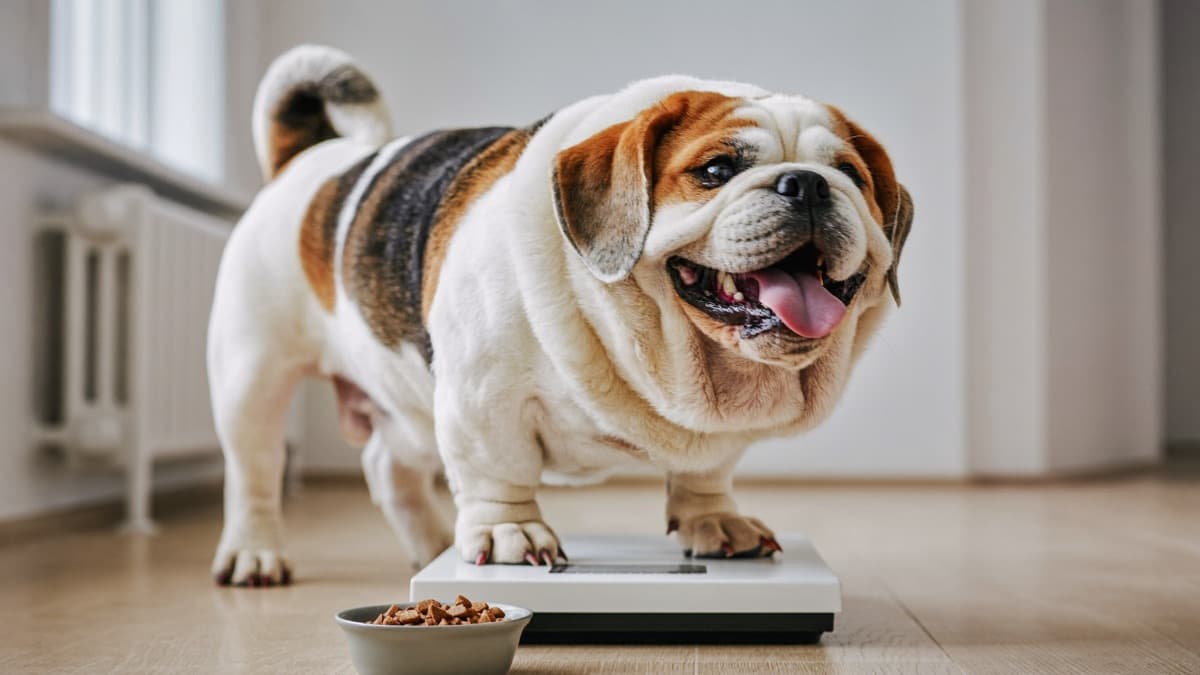
Is my dog actually overweight?
You don't need a scale to start — you need your hands. On a healthy dog you can feel the ribs easily under a thin layer of fat, see a waist when you look down from above, and see the belly tuck up behind the ribcage from the side. If the ribs are hard to find, the waist has gone, or the belly hangs level, your dog is carrying too much. Our guide to how much to feed a dog walks through the full 9-point body condition score.
Extra weight is one of the most common things vets see, so this is nothing to feel guilty about — but it is worth fixing, because the cost is real.
What counts as "diet food" for dogs?
Not all "light" bags are equal. There are two tiers:
- Over-the-counter "light" or "weight control" foods — lower in calories than the standard range, useful for a dog that is only slightly heavy or to hold a healthy weight.
- Veterinary weight-management (therapeutic) diets — the real tool for an obese dog. These are prescribed by your vet (Hill's Metabolic, Royal Canin Satiety, Purina OM and similar, all stocked by clinics in Singapore and Malaysia). They are higher in protein and fibre so your dog feels full on fewer calories, and they are fortified so a small, calorie-restricted bowl still carries a full day's vitamins and minerals.
This is the key reason not to simply pour less of your dog's usual kibble: cut a maintenance food far enough to force weight loss and you also cut the micronutrients balanced to a full portion. A weight-management diet solves for both at once.

How fast should a dog lose weight?
Slowly. The target rate that vets use is 1–2% of current body weight per week. Losing faster than that burns lean muscle alongside fat, risks nutrient deficiencies, and almost always ends in rebound.
| Dog's current weight | Safe loss per week (1–2%) |
|---|---|
| 5 kg | 50–100 g |
| 10 kg | 100–200 g |
| 20 kg | 200–400 g |
| 30 kg | 300–600 g |
Weigh your dog on the same scale once a month (most vet clinics let you drop in for a free weigh-in) and adjust the portion if the loss stalls or races. A realistic journey to a healthy weight is three to six months.
A simple, vet-backed weight-loss plan
- Start at the vet. Get a body condition score, a starting weight and a target weight, and a daily calorie figure to feed to — not the number on the bag, which is set for maintenance, not loss.
- Switch to a weight-management diet and weigh every meal in grams, not cups. A kitchen scale is the single most effective tool in dog weight loss.
- Cut treats to under 10% of daily calories, and swap high-calorie ones for crunchy low-calorie veg — plain carrot, cucumber or a few green beans. Our treat guide shows how fast treats add up.
- Stop the table scraps. A few pieces of char siu, satay or a slice of cheese can undo a whole day's careful portioning on a small dog.
- Add gentle activity, adjusted for the heat. Walk in the cooler early-morning and evening hours, build up distance slowly, and use indoor or air-conditioned play on hot afternoons. Ease into exercise for a very overweight or arthritic dog.
- Re-weigh monthly and adjust.

Why bother — the health cost of extra weight
Excess weight is not just cosmetic. It is linked to osteoarthritis and faster joint wear, diabetes, heart disease and high blood pressure, some cancers, bladder stones and higher anaesthetic risk. Most striking, veterinary sources note that being even moderately overweight can reduce life expectancy by nearly two years. Getting the weight off is one of the highest-impact things an owner can do.
When should I see the vet?
- Before starting, so weight loss is set to a target and calorie figure rather than guesswork — especially for a very overweight, senior, or arthritic dog.
- If your dog is hungry to the point of distress, or the weight will not shift on a correctly measured portion — a weight-management diet or a check for an underlying cause (such as hypothyroidism) may be needed.
- If weight is dropping faster than 2% a week without you cutting food, which can signal illness rather than a successful diet.
In Singapore, the Animal & Veterinary Service is the national authority on animal health; in Malaysia it is the Department of Veterinary Services. For a weight plan, though, your regular clinic is the place to start.