What is fear aggression, really?
Most aggression towards people that vets and behaviourists see is fear-based. The dog isn't seeking conflict or "trying to dominate" anyone — the dominance framing has been discarded by modern behaviour science — it has learnt that polite signals don't make frightening things go away, so it deploys louder ones. The tell-tale pattern: the dog barks, lunges or snaps and then retreats, aggression appears when the dog is cornered, trapped on a lead or approached in a tight space, and body weight shifts backwards even mid-display. A confident dog rarely needs to make this much noise.
Where does the fear come from? Usually under-socialisation, sometimes pain (always worth a vet check — a surprising number of "sudden aggression" cases are a sore ear or back), occasionally a genuinely bad experience, and often the daily grind of a fearful dog being approached by strangers, children or men it has repeatedly asked, quietly, to stay away.
What is the growl-snap-bite ladder?
Aggression is almost never "out of nowhere" — it climbs a ladder of escalating signals, and the bottom rungs are easy to miss:
| Rung | What you see |
|---|---|
| 1. Early appeasement | Lip-licking, yawning, head turns, whale eye |
| 2. Avoidance | Leaning away, turning away, walking off, hiding |
| 3. Freeze | Sudden stillness, closed mouth, hard stare |
| 4. Warning | Lip lift, low growl |
| 5. Escalation | Snarl, air snap (a deliberate miss, not bad aim) |
| 6. Contact | Bite — usually inhibited first, harder if ignored again |
Each rung means "the last one didn't work." A dog that bites "without warning" almost always warned for months in a language nobody read — the freezes and head turns in our dog body language guide are the ladder's first rungs. Your job is to respond at rung one or two by adding distance, so the dog never needs the top of the ladder.

Why does punishment create silent biters?
Because punishment removes the warning, not the fear. Scold, jerk or shock a dog for growling and the growl becomes dangerous for the dog to give — so it stops growling. The fear underneath is untouched; you've simply sawn the middle rungs off the ladder. The result is the most dangerous dog there is: one that goes from anxious silence straight to a bite. This is the same mechanism we describe in resource guarding, and it's why the American Veterinary Society of Animal Behavior's position statements oppose aversive training outright: confrontational methods measurably increase aggressive responses in fearful dogs.
So when your dog growls: stop, create distance, breathe. You haven't "let the dog win" — you've answered a question politely, kept your warning system intact, and collected exact information about what to train.
What does responsible management look like?
Management is the part that starts today, before any training bears fruit:
- Control the triggers. Walk at quiet hours, cross the road early, use a safe room for visitors, skip the crowded lift. Every rehearsal of lunging deepens the habit; every calm avoidance is a rep of nothing-bad-happened.
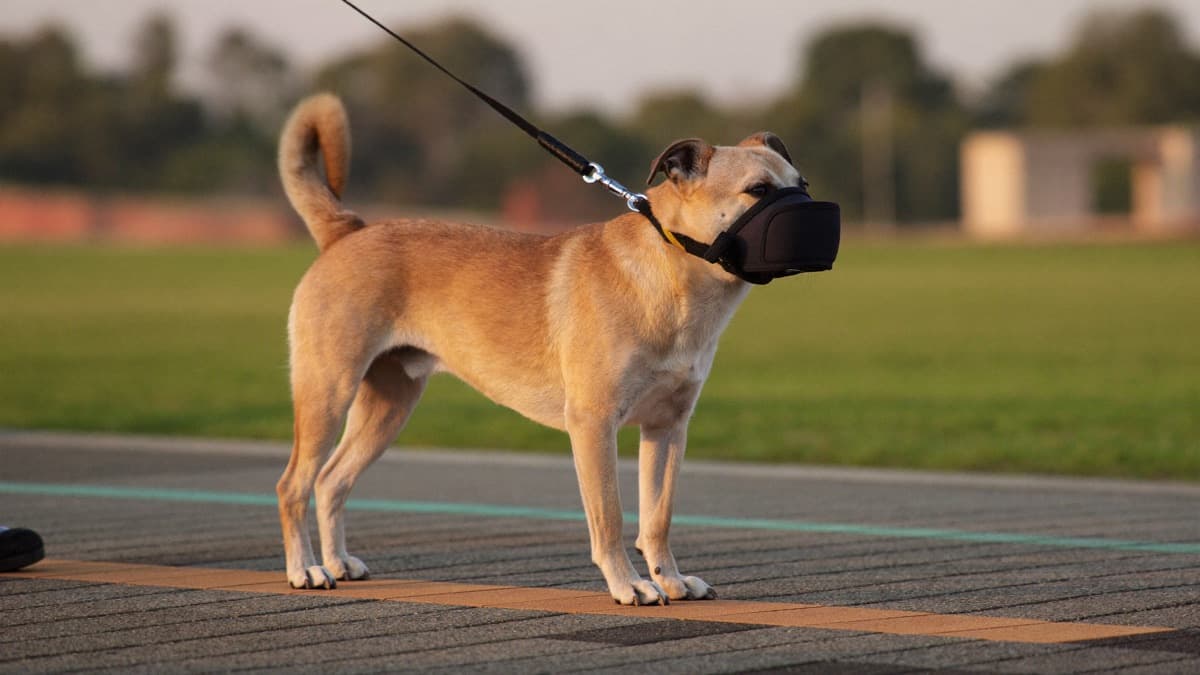
- Condition a basket muzzle. A muzzle-trained dog can be safe in vet visits, walks and training setups while remaining able to pant, drink and take treats — our muzzle training guide has the full peanut-butter ladder. A muzzle is not an admission of a bad dog; it's what responsible ownership of a frightened dog looks like.
- Train below threshold. The actual behaviour change is desensitisation and counter-conditioning: trigger appears at a coping distance, wonderful things happen, distance shrinks over weeks. This is precision work best built with a professional.
When do I need professional help?
For fear aggression with any snap or bite history, or aggression involving children: immediately — this is above the DIY line. The responsible path is a vet check first (pain hides here), then a qualified professional. In Singapore, start with the AVS-Accredited Certified Dog Trainer list for force-free credentialled trainers, and ask your vet for a referral to a veterinary behaviourist for bite-history or severe cases — behaviour consultations run roughly S$350–600 / RM500–1,000 and private training S$120–250 / RM150–400 per session, as of 2026. Avoid anyone selling dominance, "calm-assertive energy" or guaranteed quick fixes; those methods are how silent biters get made.
What happens legally if my dog bites someone in Singapore?
Take the legal reality seriously. AVS investigates reported dog-bite and dog-attack incidents — whether the victim is a person or another animal — and owners are legally required to keep dogs leashed and under control in public, with enforcement action and fines possible where control lapses (for example, a dog at large that injures someone). Depending on the incident, AVS may impose conditions on the dog's future management; check the current rules at avs.nparks.gov.sg rather than relying on forum folklore. Scheduled ("specified") breeds already carry mandatory leash-and-muzzle requirements in public. The practical takeaway: for a dog with known fear aggression, the lead, the conditioned muzzle and the professional plan aren't just kindness — they're what stands between your frightened dog and a legal file with its name on it.